


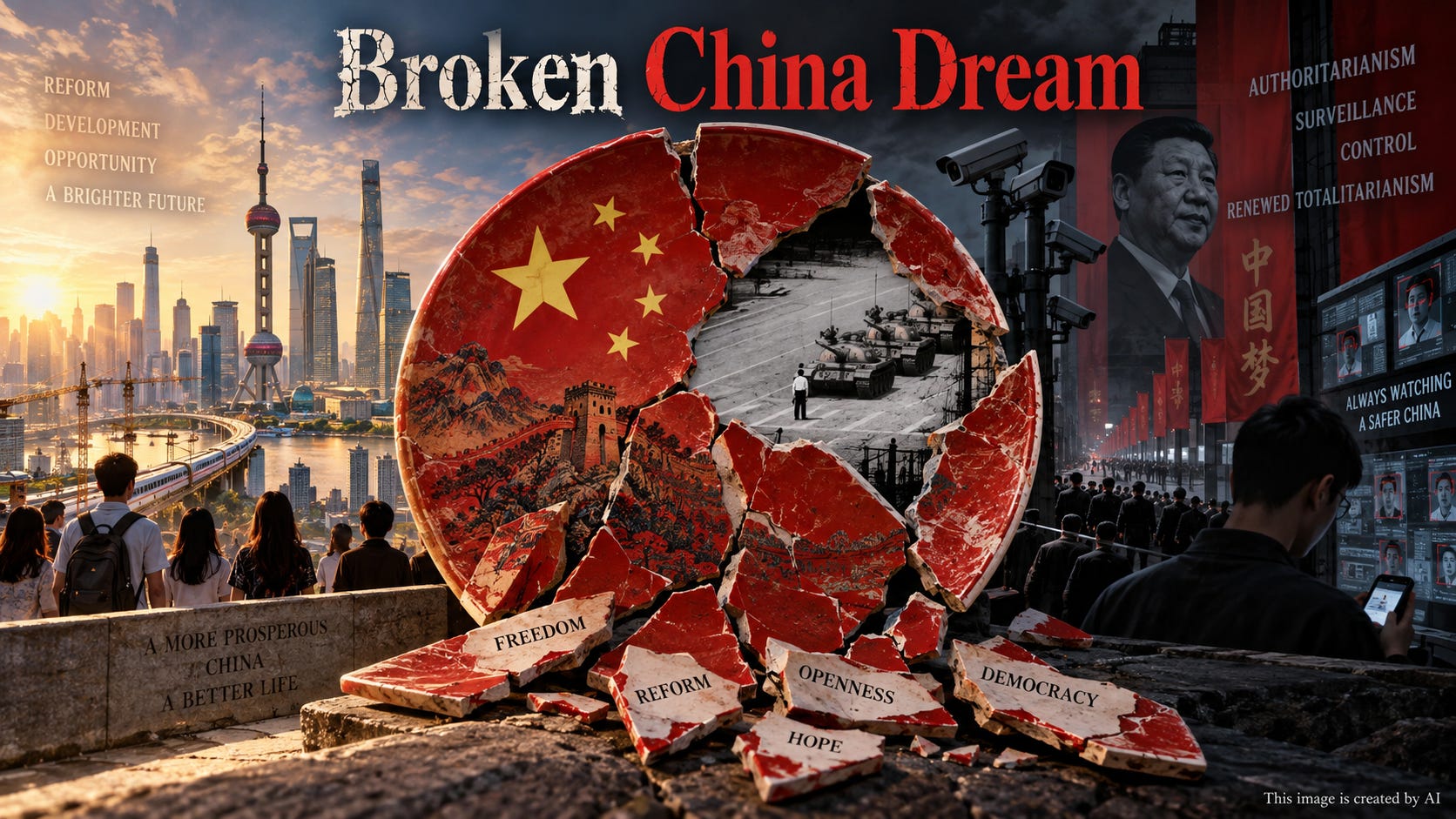
“Few should lament that Xi’s version of a ‘China dream’ will not be fulfilled. The tragedy brought about by the return to totalitarian rule and the outbreak of the new cold war under his rule is that the real China dream—an economically prosperous and politically liberal and open China—will be beyond the reach of its people for at least another generation.”
Few questions have preoccupied, and befuddled, students of contemporary China more than the failure of economic modernization to also produce political liberalization. For much of the last two decades of the twentieth century, Western governments, investors, and more than a few scholars took as an article of faith that a more prosperous China would eventually also become more politically open. According to the argument, markets would create autonomous interests, education would expand the middle class, globalization would expose its people to alternative Western ideas, and Party institutional reforms would replace personal dictatorship with a more predictable collective government. To borrow from Martin Luther King, Jr., the arc of history was long but it bent in favor of democracy.
In The Broken China Dream, Minxin Pei forcefully rejects what had been the prevailing modernization theory with a provocative reinterpretation of post-Mao China. The book is both a history of China’s reform period and an autopsy on Western expectations (hopes?) attached to it. Its subtitle captures Pei’s central thesis: the reforms that the West expected to bury Chinese Communist totalitarianism instead created a more prosperous, technologically capable party/state from which a new, more powerful form of totalitarianism could arise.
“One-party rule has persisted in China in spite of modernization mainly because the CCP not only has chosen to resist pressures for political liberalization but also has adopted effective measures to neutralize the political effects of economic development.”
Rather than asking why Xi Jinping abaondoned the Dengist reforms, Pei explores how the political economic order created by Deng Xiaoping made Xi’s reversal possible, indeed even likely. Here, he suggests that political liberalization that the West had imagined for China not only is unlikely but nearly impossible.
“…such a transition requires changes in practically every facet of the political system, economy, and society because totalitarianism rule itself is deeply embedded in them. Piecemeal reform in a totalitarian regime is unlikely to have much of an impact in terms of changing the nature of the system because the old system will retain its totalitarian essence unless the most important institutional features of totalitarianism—above all the Leninist party-state—are removed.”
“Political reform that fatally weakens the foundational institutions of totalitarianism, as in the case of the Soviet Union in the late 1980s, may be the only path to democracy for a totalitarian or post-totalitarian regime.”
In doing so, Broken China should be counted among the most consequential interpretations of Xi’s China thus far. Pei doesn’t treat Xi Jinping simply as an aberrant dictator who hijacked the Party’s reform effort. Nor does he accept that China would have continued on a path of greater openness had someone else succeeded Hu Jintao. Instead, he shows that the Party’s coercive mechanisms never really disappeared after Mao. Reform modified the Leninist system at the margins without ever dismantling it. In fact, China’s economic transformation changed almost everything except the Party’s ironclad determination to retain its monopoly on political power.
Author Spotlight
Minxin Pei is a scholar of Chinese politics and U.S.–China relations whose work has focused on authoritarianism, political reform, corruption, surveillance, and the evolution of the Chinese Communist Party. Born in Shanghai, Pei received his undergraduate education at Shanghai International Studies University before coming to the United States, where he earned a Ph.D. in government from Harvard University. He is the Tom and Margot Pritzker ’72 Professor of Government at Claremont McKenna College and previously worked at the Carnegie Endowment for International Peace.
Pei has written extensively about the political consequences of China’s post-Mao economic transformation. His other major books include From Reform to Revolution, China’s Trapped Transition, China’s Crony Capitalism, and The Sentinel State.
The 1980’s have a particularly important place in Pei’s account because they represented China’s most plausible opportunity for genuine political transformation, a view certainly up for debate. Rural decollectivization unleashed tremendous economic energy. Intellectual life underwent a brief revival. Universities opened themselves to foreign influences. Writers, filmmakers, and journalists pressed against cultural boundaries in ways that would have been unthinkable only a few years earlier. Many Chinese allowed themselves to believe that economic reform might actually spill over into the political realm, allowing a reconsideration of how their nation should be governed. And of course, for a time they had their champions in Hu Yaobang and Zhao Ziyang.
In one of the book’s strongest contributions to the conversation, Pei refuses to portray Deng Xiaoping as an unbridled reformer. Yes, Deng wanted more than anything to prevent another Mao by institutionalizing Party processes, imposing informal rules on its elites, and sparking an economic transformation. But deep in his bones, Deng remained a committed Leninist who was never willing to consider relinquishing the Party’s monopoly on power. With his “Four Cardinal Principles” (upholding the socialist path, the people’s democratic dictatorship, the CCP leadership, and Marxism-Leninism-Mao Zedong Thought), “Deng made it abundantly clear that economic modernization was the means by which to perpetuate one-party rule, and nothing else” (emphasis mine).
When prospects of political liberalization threatened that monopoly, especially in June 1989, Deng’s priorities were unmistakable. The Tiananmen massacre therefore becomes an historic watershed in Pei’s narrative. It did far more than merely terminate a democratic movement by completely foreclosing on the most promising possibilities of the entire reform period. Zhao Ziyang and his associates fell, conservatives led by Chen Yun and Peng Zhen gained temporary preeminence, and the Party learned a fateful lesson. Economic liberalization and prosperity would continue only if the political sphere remained firmly under Party control. The pillars of this approach, which Pei terms “neo-authoritarianism,” would be (1) economic prosperity, (2) renewed emphasis on nationalism, including the “victimization” narrative, and (3) an enhanced security state.
As we know, China prospered spectacularly under this bargain. Market reforms surged, foreign investment exploded, private entrepreneurship blossomed, and China’s integration into the global economy culminated in its accession to the World Trade Organization in 2001. It was a country transformed beyond recognition. Once associated in the 1970s with bicycles, food shortages, and Mao suits, China entered the twenty-first century with skyscrapers, highways, industrialization, and globally competitive corporations.
The Jiang Zemin and Hu Jintao years thus assume an ambivalent place in Pei’s history. In great detail, he outlines the unprecedented decades of economic growth and innovation. On the political side, leadership succession became somewhat more regular (although Jiang overstayed), retirement norms (not rules) established, policymaking became more regularized due to the collective leadership arrangement, and power at the top was somewhat distributed. Jiang eventually retreated from the top, while Hu transferred Party, state, and military authority to dark horse candidate Xi Jinping. From the outside, the traumas of Mao’s final decades seemed to have receded into modernization and institutionalization.
But instead of undermining Leninism, this historic economic reform financed stronger bureaucracies, more sophisticated surveillance, and tighter control over communication. Reform enriched society, but it also enriched the party/state. Where the familiar modernization narrative had assumed that capitalism would eventually overpower authoritarianism, Pei argues that authoritarianism learned to exploit capitalism first.
For Pei, these changes, norms rather than enforceable rules, left the authoritarian underpinnnings of Leninist Party rule unchecked. Still no autonomous judiciary capable of constraining the Politburo. No independent legislature checking Party power. No free press to call out official abuses. Finally, no organized political opposition capable of challenging the Party’s authority. Deng succeeded in making another Mao unlikely, but balked at establishing independent barriers capable of completely stopping one. In fact, he preserved the very controls that would allow for it to happen: Party control over the economy, enhanced surveillance mechanisms, lack of independent barriers to abuses of power. Despite the reform gloss, “totalitarianism was merely lying dormant.” Therein lies the irony, for Pei, of the reform era.
For Xi Jinping, the Party’s problems were clear and immediate. First, the Party’s oversight of China’s economic miracle had made it far too easy for cadres at all levels to line their own pockets along with those of family and associates, leading to rampant and very public levels of corruption. Second, its near-total focus on economic modernization had led to a decline in ideological work. In his mind, a similar abandonment of ideology had hastened the Soviet Communist Party’s demise. And at a very distant third, Deng’s “promise” of ever-expanding economic prosperity, the very bedrock of the post-Mao Party legitimacy, had hit a plateau and in many ways had stagnated. Thus, the Deng era abruptly and rather unexpectedly came to an end. It would be replaced, according to Pei, by the “neo-Stalin” totalitarianism of tighter and more centralized Party bureaucracy, greater Party intrusion into virtually every facet of governance and society, far greater emphasis on ideology, and seemingly never-ending purges cloaked as “anti-corruption” campaigns. The goal of these approaches were twofold: first, to strengthen the Party’s grip on China’s political, economic, and societal spheres; and second, to strengthen Xi’s grip on the Party.
After becoming general secretary in 2012, Xi accumulated power with extraordinary speed. His signature anti-corruption campaign, ongoing still today, not only rolled up countless corrupt officials but also simultaneously eliminated rivals, intimidated cadres throughout the country, and restored political fear as a central governing instrument. Party committees reinserted themselves throughout society and the economy. Civil society contracted. Lawyers, journalists, academics, activists, and religious organizations faced stricter boundaries. Surveillance capabilities expanded dramatically. Hu Jintao’s brusque and abrupt removal from the Party’s Twentieth Congress, though still not entirely explained, unmistakably marked the end of collective leadership. Pei describes Xi’s system of governance as one of personalistic rule, personality cult, recurring purges, ideological and nationalistic mobilization, and pervasive social control.
Still, Xi has not returned China to a time of Maoism. The country had a huge private economy and extensive global commercial network, highly sophisticated techology base, significantly higher personal prosperity, and facets of private life unimaginable under Mao. Instead, Pei’s characterization of “neo-Stalinism” relies on the political logic of a concentrated Leninist party operating through institutions and technologies of a modern and powerful state. Xi doesn’t need the Red Guards and mass mobilization campaigns when the party possesses massive security databases and surveillance systems, Party disciplinary commissions, and state-of the-art policing technologies. Where Mao continually mobilized society, Xi disciplines and controls it. However, Pei judges the longterm prospects for Xi’s “China Dream” to be less than positive.
“Despite his political ruthlessness and his success in amassing power and making himself the most powerful ruler since Mao Zedong, Xi’s policies have put his ‘China dream’ in serious long-term jeopardy. At home, he has all but ensured a destablizing succession struggle after he departs from the political scene. His personalistic rule has made policymaking both overcentralized and prone to costly errors…The revival of the permanent purge is terrorizing the party and most likely traumatizing and alienating those elites who do not have any direct personal connections to Xi or his faction. Similarly, his crackdown on the private sector has estranged and disillusioned China’s private entrepreneurs, the group the party had previously courted. Economically, stagnation looms on the horizon.”
The Broken China Dream enters an increasingly crowded literature on Xi Jinping. Scholars and analysts including Kevin Rudd, Elizabeth Economy, Steve Tsang and Olivia Cheung, Cheng Li, Alfred Chan, and Joseph Torigian have approached Xi and his “era” from a variety of directions. Much of that literature has concentrated on Xi himself: his formative years during the Cultural Revolution, his rise through the Party ranks, his Marxist-Leninist and nationalist ideology, and his extraordinary accumulation of personal power. Pei shifts the perspective by arguing that Xi cannot adequately be understood by beginning in 2012 or by looking at the individual alone. The political decisions and conditions enabling Xi were constructed by Party leadership during the preceding three decades.
This puts Pei into an interesting tension with those interpretations emphasizing a sharp rupture between the Deng and Xi eras. Superficially, he argues, this was true in that Xi dismantled many conventions and reversed important aspects of Deng’s domestic economic policies. But Pei finds a deeper continuity in that both regarded preservation of Communist Party rule as the paramount goal. In another regard, Pei takes issue with the view that the Jiang/Hu decades were periods of political institutionalization. He sees the moves to incorporate retirement age norms, succession practices, and collective leadership as at best halfhearted mesaures effective only when Party leaders agreed to abide by them. But not strong enough to restrain a leader determined to violate them.
Pei’s long chronological perspective is one of the book’s greatest strengths. By showing that Xi inherited a party/state still possessing incredible coercive capacity with few (if any) external constraints, and one with an overwhelming conviction for self-preservation, Pei diminishes the argument that Xi suddenly reversed China’s reform trajectory. He also very effectively counters simplistic versions (hopes?) for modernization theory. China’s experience over the past half century doesn’t mean that markets are irrelevant to political development, but does suggest that the relationship between wealth and democracy are not automatic.
I’d also suggest that prose is another virtue of The Broken China Dream. I hope Pei would find it a compliment when I say that although he is a political scientist, he writes like an historian. Arguments and narratives are clear and concise, making the book highly readable. The only exception (and a major one, in my mind) is his use of the highly-charged “neo-Stalinism” to describe Xi’s approach to governance. While Pei points to several similarities, the differences in context are as enormous as they are obvious.
The title, The Broken China Dream contains a deliberate irony and double meaning. The broken dream is not only Xi’s promise of national rejuvenation. It is also the dream widely entertained inside and outside China after Mao, that economic reform would gradually make authoritarian politics obsolete. But Pei’s history suggests something far more dark. Reform weakened some forms of Party control while strengthening the very material foundations of the Chinese state. It produced entrepreneurs and consumers, but also increased tax revenues, technological capacity, and eventually the instruments of sophisticated digital control. China escaped Maoist poverty without leaving behind Leninist politics. Deng Xiaoping’s actions in June 1989 strongly demonstrate that political liberalization was never a realistic alternative.
This is what makes Pei’s book more than just another study of Xi Jinping. It is an argument and history of the entire post-Mao period. Deng attempted to leverage the dynamism of markets without allowing the pluralism that would challenge Party power. For two decades, that compromise seemed to have worked. The Party modernized, professionalized, enriched itself, and learned to govern a vastly complicated society without surrendering the institutional machinery required for concentrated political control. Whether “neo-Stalinism” ultimately proves to be the best label for the resulting system may be debated for some time. But what comes through very clearly is that Deng’s reforms built a powerful modern China that Xi would inherit. They also left intact the Leninist Party that Xi would use to dominate it.
Minxin Pei's argument makes perfect sense. Deng Xiaoping was never a democrat, but a shrewd and experienced pragmatic leader. So was Chen Yun, who Xi Jinping recently lauded. China's sheer size and centrifugal (regional) forces creates a "need" for a strong center. Lacking a democratic tradition, this paved the way for Xi.
My take on Xi: Navigating Troubled Waters
https://nordiclink.substack.com/p/navigating-troubled-waters?r=7f7u6&utm_campaign=post-expanded-share&utm_medium=web